How I create Apify Actors people actually pay to use
First Store submit, eight live Actors, the Graveyard, and the Playbook that grew out of the packaging scars.
Read time: ~12 minutes
This is my builder story — not an AI news roundup or a polished case-study brochure. If you have only seen Apify in a tools list, start with the next section.
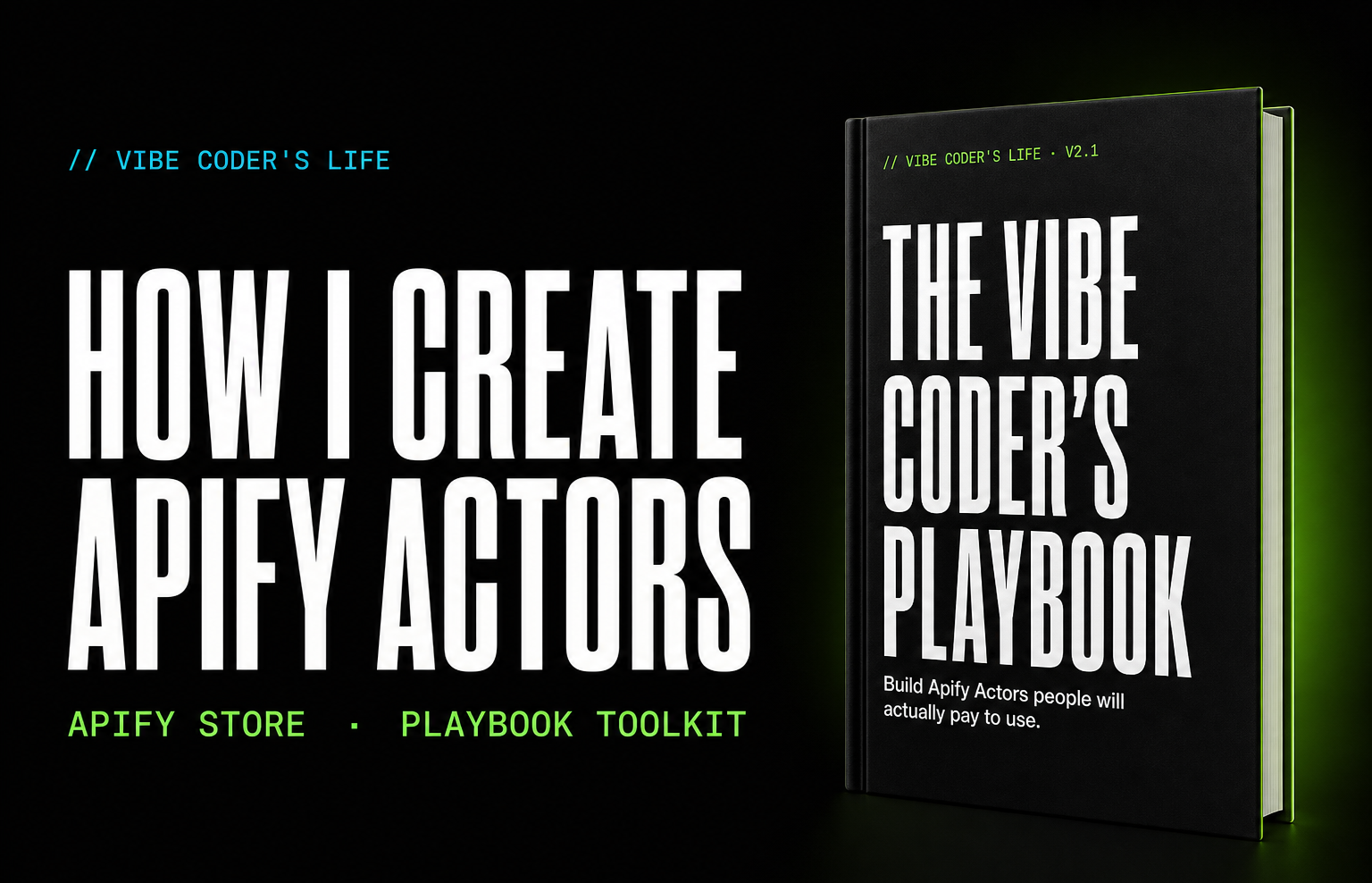
I used Cursor daily, shipped Actors to the Apify Store, killed ideas that looked good on a whiteboard, and wrote down what hurt so I would not forget it. That became The Vibe Coder's Playbook: Build Apify Actors people will actually pay to use — the same packaging scars, prompts, and checklists I wish I had before my first serious submit. Vibe Coder's Life is where I share the messy parts on purpose.
What is Apify?
Apify is a cloud platform for Actors. An Actor is a packaged scraper or automation: a form for inputs, a cloud run, a dataset (or files) out the other side, optional schedules, and a public listing on the Store.
You do not have to build your own billing, hosting, or “run this job” UI. Buyers pay Apify compute (and your pricing if you charge per event). You iterate the Actor; they rerun it.
That is why vibe coders should care. Most AI-built scrapers die as a local script. The Store is one of the few places an indie can put a real product in front of strangers and get paid without standing up a SaaS. It only works if you treat the Actor like a product — QA-safe defaults, an honest README, pricing that matches what the code actually charges — not a weekend demo.
Why I started building Actors
I did not start from “I should be on the Store.” I started from work I already do: find suppliers, check who they are, follow dealer networks, pull public PDFs, notice when a page changes, look at station fuel prices, export a catalog, watch wildfire feeds.
Doing that as a pile of notebooks does not scale. Doing it as Store Actors meant I could rerun the same pipelines, and other people could buy one step without buying the whole suite.
Shipping them also forced the packaging lessons the Playbook is about: Store review, prefills, PPE, READMEs. I would rather share that path than pretend the listings appeared fully formed.
First Actor submit — what actually hurt
My first serious submit taught me more than any Academy skim:
- QA-safe prefills matter more than clever crawlers. If the default Store “Try it” run burns time or money, review stalls.
- README honesty (“what this score is not”) prevents support debt.
- PPE events need to match what you actually charge in code — drift feels like a “bug” when it is packaging.
- Local green ≠ cloud green. Proxies, timeouts, and memory lie until you smoke on the platform.
That packaging pain is why the toolkit exists: templates, checklists, and prompts aimed at shipping, not inventing another scraper tutorial.
Eight live Actors (and not another Maps clone)
I wanted Actors with a sharp buyer sentence, public pages / open feeds, and wedges that are not “yet another generic scraper.” Each listing sells alone; some chain.
Supplier research
Discover → enrich → docs → watch:
| Stage | Actor | Store |
|---|---|---|
| Discover | Google Maps CEE Scraper — Supplier Shortlist | google-maps-cee-scraper |
| Channel map | Dealer / Distributor Locator Extractor | dealer-distributor-locator |
| Enrich | Website Intelligence + Contact Extractor | website-intelligence-contact-extractor |
| Docs | PDF Procurement Document Extractor | pdf-procurement-document-extractor |
| Watch | Website Change Monitor — Diff Tracker | website-change-monitor |
E-commerce
| Stage | Actor | Store |
|---|---|---|
| Catalog | Product Catalog Scraper — Shopify CSV, WooCommerce & Shoprenter | product-catalog-scraper |
Location intelligence
| Stage | Actor | Store |
|---|---|---|
| Fuel | European Fuel Station Prices API (CEE + DACH) | cee-dach-fuel-intelligence |
| Wildfire | Wildfire Intelligence API — US WFIGS + Europe EFFIS | wildfire-intelligence |
Maps leads with scoring and CEE language; Dealer targets locator layouts; Website Intel adds impresszum / compliance flags; PDF focuses procurement docs; Monitor closes the loop on public page change; Catalog writes Shopify / Woo / Shoprenter CSV; Fuel normalizes CEE+DACH station prices; Wildfire pulls official US + EU fire feeds.
Typical chain: Maps or Dealer Locator → Website Intel → PDF / Change Monitor. Fuel + wildfire sit beside that as location APIs. Catalog is a separate storefront line.
Profile: apify.com/kondasviktor — eight published Actors at the time of writing.
The Graveyard — what I did not build
Sharing failures is the point of Vibe Coder's Life.
I killed a media / video downloader path: Store saturation plus copyright surface that is not the same category as public business facts. I walked away from capital-heavy sovereignty / routing gateway ideas that need infrastructure budget I do not have. Store research also rejected trade-show booth scrapers (DOM churn), finite SaaS partner directories (no recurring run), and head-on LinkedIn/job clones.
Saturated platforms (YouTube / Instagram / Amazon / Booking-style clones) look like demand and behave like maintenance and ToS traps for indie publishers. The Playbook’s Graveyard chapter is that judgment written down — what to build instead.
What worked vs what broke
Worked: suite cross-links without forcing a monolith; BYOK AI off by default; deterministic value first; example tasks named for humans; public-data framing in READMEs.
Broke / burned time: language-specific Maps DOM labels; prefills that were too heavy for QA; README drafts that read like feature dumps; underestimating proxy cost vs event price.
Those notes became checklists and prompts — not motivational filler.
The toolkit that grew out of this
I did not set out to sell a PDF. I set out to stop re-explaining the same Store packaging mistakes in DMs.
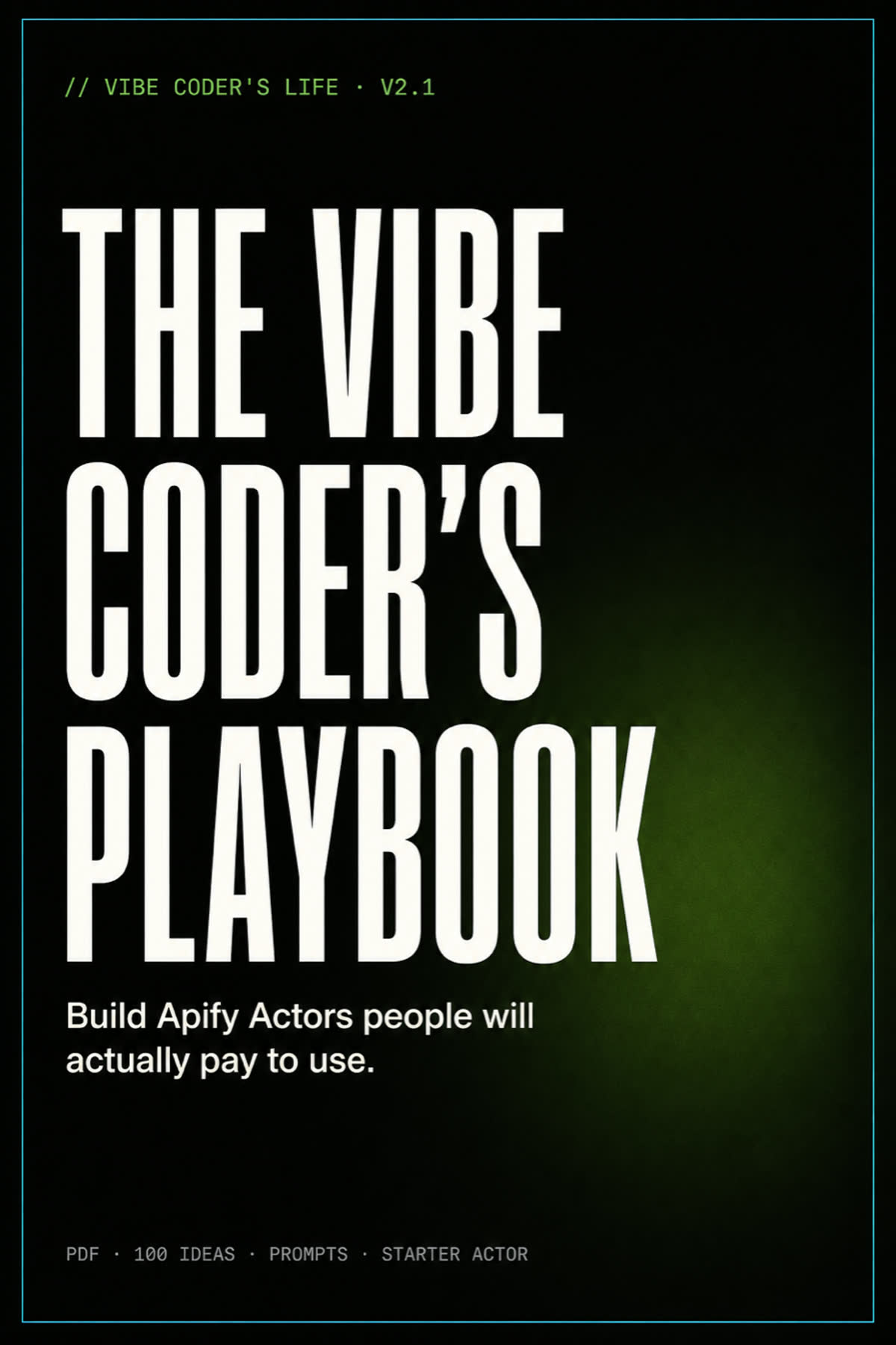
The Vibe Coder's Playbook: Build Apify Actors people will actually pay to use is the system behind the story above:
- 104-page playbook — validation, PPE economics, Crawlee, Cursor workflows, Store SEO, pricing, Graveyard judgment, case studies
- 100 Actor ideas (CSV + Markdown) with difficulty and maintenance ratings
- 80+ AI prompts + shared constraints so assistants stop inventing APIs
- Runnable TypeScript starter Actor (books.toscrape.com demo — not my production Store scrapers)
- Templates, worksheets, and launch checklists
€37 once · personal download by email after Stripe Checkout · no subscription.
The post is the journey. The toolkit is the repeatable shipping loop — buyer sentence → Graveyard check → PPE model → QA-safe schema → cloud smoke → Store packaging. Same framing as the toolkit page.
No fake urgency. If this story resonated and you want the files, start there.
Want the system, not just the story?
104-page PDF · 100 ideas · 80+ prompts · starter Actor · templates & checklists
Explore the toolkit — €37 →Start building
- Create an Apify account (referral) if you are new to the platform.
- Browse the Actors above — steal the patterns, not necessarily the niches.
- If you buy the toolkit, open START-HERE.md first inside the zip.
If you need help beyond the toolkit — a quick Actor review, a fixed-price Starter Actor, custom multi-Actor work, or maintenance after launch — email hello@vibecoderslife.com. Happy to support when it is useful; no pressure either way.
Sources: Apify Store profile (eight live Actors); Apify docs; The Vibe Coder's Playbook.
Disclosure: Apify signup is a referral link (same as on our Tools page). Cursor homepage links are non-referral after the referral program ended. No paid placement by Apify for this article.
Questions? Get in touch — or subscribe.