OpenAI DevDay 2026 + September AI recap: GPT-6, Claude 5.5, Gemini 3.8, Grok 4.7
Every DevDay launch from dots to Pro 500, plus the month’s model drops — GPT-6 Astra, Sol and Luna, Claude Opus 5.5 and Sonnet 5.5, Gemini 3.8, Grok 4.7 in Cursor — with prices, free tiers, and what actually works from Hungary and the EU.
~15 min read
September started with an outage and ended with a keynote — then Google closed the month with Gemini 4 Argon. In between, every frontier lab shipped: OpenAI released a whole new model family, Anthropic kicked off Claude 5.5, Google pushed Gemini 3.8 into Flash and Live, and SpaceXAI and Cursor shipped Grok 4.7. OpenAI’s DevDay on 29 Sep added more than 20 launches in a single afternoon.
I followed most of it week by week in the newsletter. This post puts the whole month on one page so you can see what changed, what it costs, and what you can actually use from here. I’m in Hungary on ChatGPT Plus, so EU availability gets its own section.
September at a glance
| Provider | Release | What it is | Date | Availability / price |
|---|---|---|---|---|
| Anthropic | Claude Fable 5.1 | Flagship for coding and knowledge work (Mythos 5.1 = same model, trusted access only) | 1 Sep | All platforms; $10 / $50, cache reads $0.25 |
| Gemini 3.8 Flash | Flash-priced reasoning and coding model (+ 3.8 Flash Cyber for vetted defenders) | 2 Sep | Free API tier; paid $0.75 / $3.75 until 31 Dec; Gemini app on AI Pro / Ultra | |
| OpenAI | GPT-6 Astra | New flagship model | 3 Sep | ChatGPT Plus and up; API $10 / $50 |
| Meta | Muse | Personal AI agent in its own app and WhatsApp | 8 Sep | US (now US + Canada); free for most use |
| OpenAI | ChatGPT Images 2.5 | New image model, up to 50% lower latency than Images 2.0 | 8 Sep | All ChatGPT users + API |
| OpenAI | Agents API | The Codex harness as a managed API | 10 Sep | Public beta; no extra fee, pay for tokens and tools |
| OpenAI | GPT-Live-1 in the API | Full-duplex voice model for voice agents | 10 Sep | API |
| Gemini 3.8 Live + Live Extended Thinking | Real-time voice models that run tools while they talk | 15 Sep | Live API $0.005/min audio in, $0.018/min out; Search Live for everyone | |
| SpaceXAI / Cursor | Grok 4.7 | Long-running coding and knowledge-work model | 21 Sep | Every paid Cursor plan, incl. EU; API $2 / $6 |
| Anthropic | Claude Opus 5.5 | First Claude 5.5 model; Fable-level on most work | 22 Sep | All platforms; $4 / $20, cache reads $0.20 |
| OpenAI | GPT-6 Sol + GPT-6 Luna | Cheaper GPT-6 tiers | 22 Sep | Sol $2 / $10, Luna $0.10 / $0.50; ChatGPT Work + Codex on Plus and up; Luna for Free / Go in the desktop app |
| Gemini 3.8 Live with Live Avatar | Lip-synced avatar on top of 3.8 Live | 24 Sep | Gemini Enterprise | |
| Anthropic | Claude Sonnet 5.5 | Faster, cheaper everyday Claude | 28 Sep | All platforms; $2 / $10, cache reads $0.20 |
| OpenAI | dots | Always-on agents with their own cloud computer | 29 Sep | Pro (not EEA / CH / UK) + Business Premium; first dot included |
| OpenAI | GPT-6.1 Sol | Near-Astra coding and computer use at a fifth of Astra’s price | 29 Sep | ChatGPT Work + Codex on Plus and up; API $2 / $10 ($0.10 cached) |
| OpenAI | Astra Ultrafast + Pro 500 | Fastest API tier + new $500/month plan | 29 Sep | API $60 / $300; ChatGPT Work + Codex on Pro 500 and Enterprise |
| OpenAI | Decisions API | Luna picks from answers you define | 29 Sep | Limited preview; no public price yet |
| Gemini 4 Argon | Frontier model for coding, knowledge work, and cyber defense (watch) | 30 Sep | Fairwind only for now; intro API $2 / $10 (later $4 / $20); broader paid API + AI Ultra later |
API prices are USD per 1M input / output tokens, standard tier. Checked against provider pages on 30 Sep 2026.
OpenAI before DevDay: the GPT-6 family
OpenAI opened the month with GPT-6 Astra on 3 Sep, the same morning a chunk of the stack went dark (that story is here). Astra lists at $10 / $50 per million tokens in the API, with a Fast mode at twice the speed and twice the price. In ChatGPT it rolled out to Plus, Pro, Business, and Enterprise.
On 22 Sep came the cheaper tiers: GPT-6 Sol and GPT-6 Luna. OpenAI cut prices 50% against the GPT-5.6 promo pricing. Sol is now $2 / $10 and Luna $0.10 / $0.50. There’s no GPT-6 Terra. If you’re still routing Sol / Terra / Luna like I described in my one month with Codex post, Terra’s slot is simply gone. The free angle: Free and Go users can use GPT-6 Luna in the ChatGPT desktop app, inside ChatGPT Work.
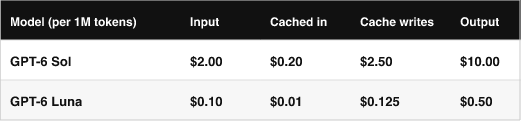
GPT-6 Sol and Luna API list prices (per 1M tokens, short context). Cached input on Sol was $0.20 at launch; GPT-6.1 Sol later cuts that to $0.10.
Two smaller launches matter for builders too. ChatGPT Images 2.5 (8 Sep) is available to all ChatGPT users, with up to 50% lower latency than Images 2.0 plus a new Sketch feature. On 10 Sep, GPT-Live-1 arrived in the API for voice agents, and the Agents API went into public beta. The Agents API is the Codex harness run by OpenAI, with no extra fee on top of tokens and tools, and sandbox partners including Vercel, Cloudflare, E2B, Modal, and Daytona.
OpenAI DevDay 2026: everything announced
DevDay ran on 29 Sep in San Francisco. OpenAI’s own recap counts more than 20 major announcements and says ChatGPT now has 1.2 billion weekly users. Here’s all of it, grouped the way I’d think about it as a builder.
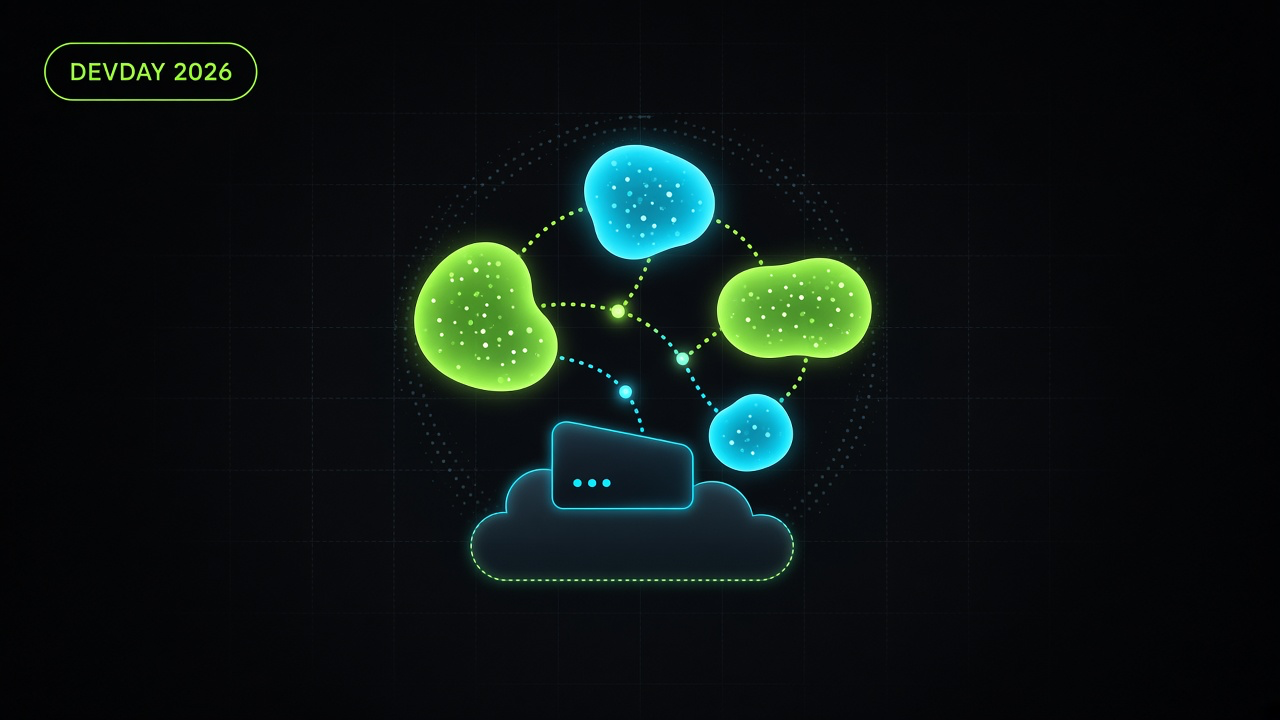
DevDay’s headline product: always-on dots — agents with their own cloud computer, not just another chat model.
Dots: agents that keep working when your laptop is closed
Dots are always-on agents powered by GPT-6 Astra. Each dot has its own cloud computer and browser, connects to over 4,000 apps through plugins, and learns your preferences over time. You can message or call it in ChatGPT, Slack, or Teams, with texting coming soon. While you’re away, it does “proactive research” with read-only tools. Real actions go through auto-review and your Custom Rules, and some things, like changing a password, always stay with you.
- Who gets it: Pro users outside the EEA, Switzerland, and the UK; Business Premium in all supported ChatGPT regions; Enterprise, Edu, and Healthcare as an admin-enabled beta (OpenAI Help Center).
- Cost: your first dot is included in Pro or Business Premium. Chatting with it doesn’t count toward ChatGPT limits, but tasks it starts in Codex or ChatGPT Work do.
- Specialist dots with their own identity and credentials are in enterprise pilots, with a Microsoft Agent 365 integration in the works.
It’s OpenAI’s answer to always-on agents like Meta’s Muse and Grok Bot. For a solo builder, the dev use case OpenAI shows is the interesting one: a dot watches customer feedback, scopes small fixes, and brings you tested PRs with videos attached.
ChatGPT Space, Pages, slides, and team work
- ChatGPT Space replaces Library. It’s a shared home where teammates, ChatGPT, Codex, and your dot work from the same context. It’s on Pro, Business, and Enterprise (web and desktop), with read-and-share on mobile.
- Pages are a new document type for people and agents. You can write, research, chart, and visualize in them, and they can update themselves from connected tools on a schedule.
- Collaborative slides are coming to Pro, Business, and Enterprise in the next few weeks, with export to PowerPoint or Google Slides. Collaborative spreadsheets are listed as “coming soon.”
- Teams and team tasks (Business and Enterprise) run recurring work on a schedule or when an event fires, like a new email or Slack message.
- @ChatGPT in Slack and Microsoft Teams works in channels, threads, and DMs, and teammates don’t each need a ChatGPT license. It’s available globally on Business and Enterprise (details).
- Meetings plugin takes notes and saves summaries with action items to Space. The audio is deleted once the notes are ready. It’s in beta in the macOS desktop app for Pro and Business, with Enterprise coming soon.
Models, speed, and the new Pro tier
- GPT-6.1 Sol is an upgrade to GPT-6 Sol at $2 / $10 per million tokens, with cached input at $0.10. It’s in ChatGPT Work and Codex for Plus and up, and it’s the default model shown in the Codex CLI docs. The benchmark details are in this week’s newsletter.
- Ultrafast: GPT-6 Astra Ultrafast is OpenAI’s fastest API tier, with up to 8x faster speeds than Standard mode. The price is $60 / $300 per million tokens, six times Astra’s standard rate. In ChatGPT Work and Codex it’s on Pro 500 and Enterprise. GPT-6.1 Sol Ultrafast is coming soon.
- Pro 500 costs $500 a month, offers 25 times the Plus allowance, and is the only Pro tier with Ultrafast. Pro 200 is open to new subscribers again, but with a lower allowance. Eligible existing Pro 200 subscribers keep their old allowance until 29 Oct 2026.
Codex and the API
- Codex in the cloud lets you start a task on your computer, from your phone, or in the cloud, using reusable environments with shared, approved settings. It’s on Plus, Pro, Business, Healthcare, Education, and Enterprise.
- A refreshed Codex CLI adds voice for starting and steering tasks, a new
/agentsview for tracking parallel work, better prompt editing, session resume, worktrees, and a cleaner terminal UI (docs). - Code Review in the ChatGPT desktop app shows summaries and diffs and lets you question Codex before you comment on GitHub PRs or GitLab MRs. Automatic cloud reviews can run while you’re away.
- Codex Security Cloud scans connected GitHub repos on demand or on a schedule, watches new commits, removes duplicate findings, and prepares fixes in the cloud. It’s a research preview.
- Agents API + computer use: agents built on the Agents API can now operate software through an OpenAI-hosted browser. It’s in the API, and in Codex and ChatGPT Work on Pro 500 and Enterprise. The open-source Codex harness underneath is the same one that powers dots.
- Decisions API: you define questions with a fixed set of answers, send text or images, and GPT-6 Luna picks one. It’s built for classifying, routing, or choosing an agent’s next step. It went into limited preview on 29 Sep, with a broad release “in the coming days”. There are no public docs, price, or EU availability details yet.
- Bedrock Managed Agents, powered by OpenAI, runs OpenAI agents entirely inside AWS.
- Private Intelligence offers Zero Data Retention with Private Safety Processing, which means automated safety reviews without OpenAI staff seeing the content. A Private Inference preview on confidential computing is coming this fall (interest form).
Plugins inside ChatGPT
- Plugin extensions let your plugin live in ChatGPT’s sidebar, open panels next to a conversation, act as a viewer or editor for your file types, and add rich forms. Canva, Figma, and Adobe already use them. They’re on all plans, and web support for Free and Go is “coming soon.”
- Plugin Creator, a clearer submission flow, and better in-conversation recommendations are on all plans.
- Sites can host plugins, so teammates use the same app with their own data (Business, Enterprise, Healthcare, Edu).
- MCP Events support lets a connected app trigger a ChatGPT automation when something changes. It’s on all plans.
- Shareable profiles showcase your Sites and plugins, on every plan from Free to Enterprise.
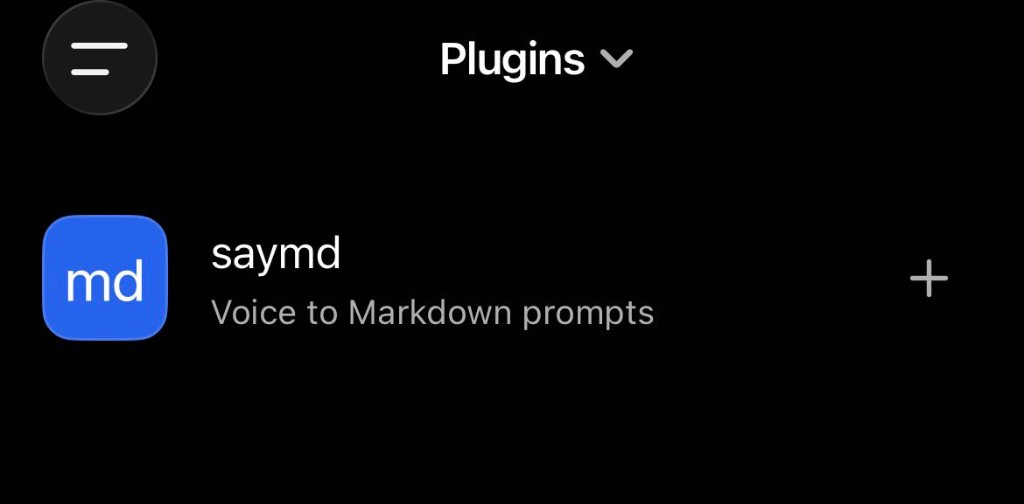
saymd live in ChatGPT / Codex Plugins — the same catalog plugin extensions now expand into.
Do more with your subscription
- Sign in with ChatGPT: plan usage from Plus and Pro works across 16 partner tools, including Devin, Notion, Vercel, T3, OpenClaw, and Dactyl, with per-app limits. Identity sign-in is available globally. It shares your name, email, and avatar, never your chats or memory.
- OpenAI Marketplace lets eligible enterprises spend part of their existing OpenAI commitment on 32 partner products, including Figma, Adobe, Salesforce, Vercel, and Lovable. It’s enterprise-only and runs through an expression-of-interest process.
Anthropic: Fable 5.1, then the Claude 5.5 family
Anthropic shipped three times. Claude Fable 5.1 (1 Sep) is the top model, with cache reads cut 75% to $0.25 per million tokens. Mythos 5.1 is the same model with looser safeguards, and it’s limited to trusted-access programs, currently for US organizations only.
Claude Opus 5.5 (22 Sep) opened the 5.5 family. Anthropic says it performs at Fable 5.1’s level on most work and costs about 40% less to run than Opus 5, at $4 / $20 with $0.20 cache reads. It also came with higher five-hour usage limits on Pro, Max, Team, and seat-based Enterprise plans.
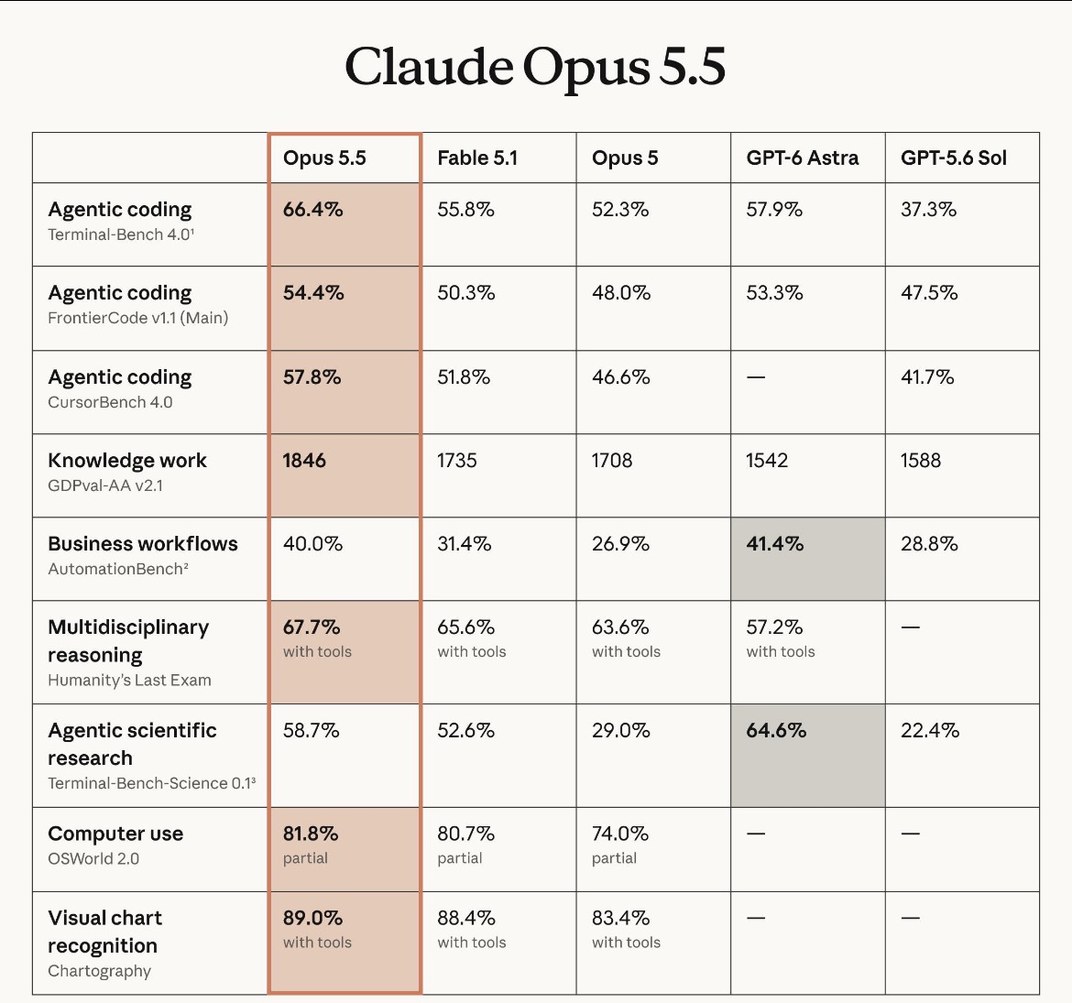
Anthropic’s Opus 5.5 comparison table (Opus 5.5 column highlighted) — Terminal-Bench 66.4%, CursorBench 57.8%, GDPval-AA 1846. Image credit: Anthropic.
Claude Sonnet 5.5 (28 Sep) is the one I’d default to for everyday vibe coding. It costs $2 / $10, the same as Sonnet 5, and Anthropic says it runs 30%+ faster and costs up to 30% less per task. Both 5.5 models have a 1M-token context window. Haiku 5.5 is due “in the coming weeks.”
Sonnet 5.5 — the $2 / $10 everyday Claude. Image credit: Anthropic.
Google: Gemini 3.8, then Gemini 4 Argon (watch)
Gemini 3.8 Flash (2 Sep) was Google’s third Flash release in six weeks, following 3.7 Flash. Paid API pricing is still the introductory $0.75 / $3.75 until 31 Dec 2026, rising to $1.50 / $7.50 on 1 Jan 2027. The Gemini API free tier covers 3.8 Flash too, which makes it the easiest free frontier-class key of the month. In the Gemini app, 3.8 Flash is for AI Pro and Ultra subscribers.
Gemini 3.8 Live and 3.8 Live Extended Thinking (15 Sep) are voice models that keep talking while tools run in the background. In the Live API they cost $0.005 per minute of audio input and $0.018 per minute of output, and 3.8 Live powers Search Live for everyone. On 24 Sep, Live Avatar added a lip-synced face on top, for Gemini Enterprise only.
Then on 30 Sep, Google DeepMind announced Gemini 4 Argon — a frontier model aimed at long-horizon coding, enterprise knowledge work, and cybersecurity defense. Introductory list price is $2 / $10 per million tokens (cached input 95% off), rising later to $4 / $20. For now it’s only rolling out through Fairwind, Google’s program for trusted cyber defenders. Broader access is promised later, starting with the paid API and Google AI Ultra — so for most vibe coders this week it’s a watch, not something you can try yet. Keep using 3.8 Flash (including the free tier) until Argon opens up.
SpaceXAI and Cursor: Grok 4.7
Grok 4.7 (21 Sep) is built on a larger base than Grok 4.6 and was trained on harder, multi-hour tasks. It keeps the same price and speed: $2 input / $6 output per million tokens, with a fast variant at twice the speed and twice the price. In Cursor it’s a first-party model on every paid plan, drawing from the Cursor Models usage pool. It has a 256k standard context window (500k long context) and four effort levels. Cursor says it’s available in the EU. Composer stays for fast everyday edits. Also from Cursor this month: my hands-on with Cursor Origin Git hosting.
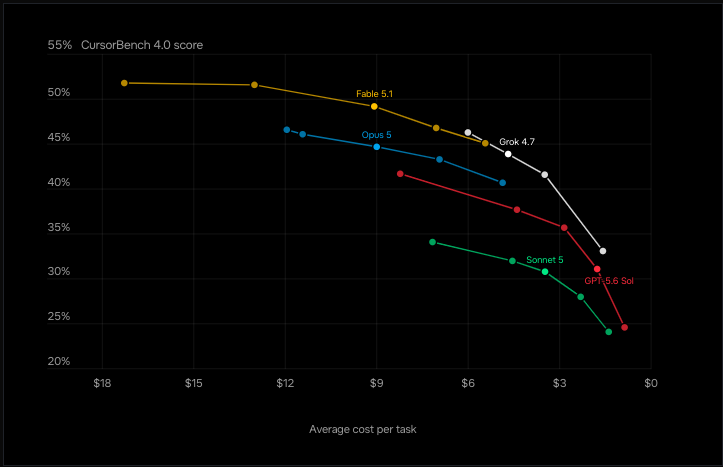
CursorBench 4.0 vs average cost per task — Grok 4.7 sits in the mid-performance / mid-cost band. Image credit: Cursor / xAI launch materials.
Meta: Muse
Meta launched Muse on 8 Sep. It’s a personal agent that runs on its own secure VM and takes orders in the Muse app or WhatsApp. It’s free for most use, with subscriptions for more, but only in the US and Canada so far. Dots are OpenAI’s paid, work-first take on the same idea.

Meta Connect also showed Muse Charm — keychain hardware for the Muse agent (US holiday-window aim). Software Muse itself is still US + Canada. Image credit: Meta.
What works from Hungary and the EU
- Dots: not on Pro in the EEA, Switzerland, or the UK. Business Premium gets them in all supported regions.
- Ultrafast: supports US data residency and global processing only, with no EU regional processing. GPT-6.1 Sol supports both US and EU data residency, though Fast mode isn’t available with EU residency. OpenAI’s regional endpoints carry a 10% price uplift for newer models.
- Meetings plugin: macOS desktop app only for now.
- Muse: US and Canada only.
- Grok 4.7 in Cursor: available in the EU.
- Claude 5.5 and Gemini 3.8 Flash: the launch posts don’t list regional carve-outs. Anthropic ships Opus 5.5 with watermarking to comply with the EU AI Act.
- Gemini 4 Argon: Fairwind partners only for now — not a general Google AI Studio / Gemini app drop. Broader paid API + AI Ultra comes later.
- On my Plus plan: GPT-6.1 Sol in Codex, Codex in the cloud, and Sign in with ChatGPT plan usage, yes. Dots, Space, and Ultrafast, no. Those need Pro, Business, or Pro 500.
What I’d actually do with this as a vibe coder
- Re-pick your default model. Sonnet 5.5, GPT-6.1 Sol, and Grok 4.7 all sit around $2 input. Try one real ticket on each in Cursor or Codex before you pay for more.
- Keep a free key warm. Gemini 3.8 Flash on the AI Studio free tier is the obvious backup. My free AI API keys guide has the rest.
- Skip Pro 500 unless waiting is your bottleneck. Six times the token price for speed is a team tool, not a side-project tool.
- If you build plugins, look at extensions now. Sidebar apps and file viewers are the new distribution surface — see the saymd callout above.
- Learning? OpenAI Academy added a Build with AI path for developers on 21 Sep. My free vibe coding courses list is still the best place to start.
FAQ
What did OpenAI announce at DevDay 2026?
More than 20 launches on 29 Sep 2026. The headliners: dots (always-on agents with their own cloud computer), GPT-6.1 Sol, Astra Ultrafast and a $500/month Pro 500 plan, ChatGPT Space with Pages, Codex in the cloud, a refreshed Codex CLI, Codex Security Cloud, computer use in the Agents API, the Decisions API preview, plugin extensions, Sign in with ChatGPT, and the OpenAI Marketplace. Full list.
How much does GPT-6.1 Sol cost?
In the API, GPT-6.1 Sol lists at $2 input, $0.10 cached input, and $10 output per million tokens. That is the same list price as GPT-6 Sol for input and output, with cached input cut in half. OpenAI positions it as near-Astra coding and computer-use performance at about a fifth of Astra’s $10 / $50 standard rates. Batch and Flex are 50% off. It is in ChatGPT Work and Codex for Plus, Pro, Business, Enterprise, and Edu, but not yet in ordinary Chat.
GPT-6 Astra vs GPT-6.1 Sol — which should I use for coding?
Default to GPT-6.1 Sol for everyday agentic coding and computer use. OpenAI says it nearly matches GPT-6 Astra on those workloads at about a fifth of Astra’s standard token price. Keep Astra (or Astra Ultrafast on Pro 500 / Enterprise) for the hardest problems where you still want the flagship, or when Ultrafast’s speed is the bottleneck. On Plus, Sol in Work and Codex is usually the better default than paying up for Pro 500.
What are OpenAI dots, and can I use them in the EU?
Dots are always-on ChatGPT agents powered by GPT-6 Astra. Each one gets its own cloud computer and browser, connects to your apps, and asks for approval on sensitive actions. As of 30 Sep 2026, Pro users in the EEA, Switzerland, and the UK are excluded. Business Premium gets dots in all supported ChatGPT regions, and Enterprise can enable a beta. Hungary is in the EEA, so Pro does not get dots there.
OpenAI dots vs Muse vs Grok Bot — what’s the difference?
All three are always-on agents with their own computer-style workspace. Dots run on GPT-6 Astra inside ChatGPT (Pro outside the EEA/UK/CH, or Business Premium), with deep Codex and Work integration. Meta Muse is a personal agent in its own app and WhatsApp, free for most use, but US and Canada only so far. Grok Bot is SpaceXAI’s agent product; Grok 4.7 itself is separately available as a coding model in Cursor on every paid plan, including the EU. Pick by region and stack: Cursor + Grok for coding in the EU, Muse if you are in the US/Canada, dots if you are on an eligible ChatGPT plan outside the EEA carve-out.
Is ChatGPT Pro 500 worth it?
Only if speed is your bottleneck. Pro 500 costs $500 a month, offers 25 times the Plus allowance, and is the only Pro tier with Ultrafast. Pro 100 and Pro 200 do not get Ultrafast, even with credits. New Pro 200 subscriptions come with a lower allowance than before, and eligible existing subscribers keep the old allowance until 29 Oct 2026. For most solo vibe coders, Plus or Pro 100 plus a cheaper model like GPT-6.1 Sol is the better deal.
What is ChatGPT Astra Ultrafast, and who gets it?
Astra Ultrafast is OpenAI’s fastest GPT-6 Astra tier — up to about 8× faster than Standard. In the API it lists at $60 input / $300 output per million tokens (six times standard Astra). In ChatGPT Work and Codex it is on Pro 500 and Enterprise. Ultrafast supports US data residency and global processing only, with no EU regional processing. GPT-6.1 Sol Ultrafast is listed as coming soon.
What AI models were released in September 2026?
The big ones: Claude Fable 5.1 (1 Sep), Gemini 3.8 Flash (2 Sep), GPT-6 Astra (3 Sep), Gemini 3.8 Live (15 Sep), Grok 4.7 (21 Sep), Claude Opus 5.5 and GPT-6 Sol and Luna (22 Sep), Claude Sonnet 5.5 (28 Sep), GPT-6.1 Sol at OpenAI DevDay (29 Sep), and Gemini 4 Argon (30 Sep — Fairwind only for now). The at-a-glance table has dates, prices, and availability for each one.
Claude Sonnet 5.5 vs Opus 5.5: which should I use for coding?
Use Sonnet 5.5 as your default for bugs, features, and well-scoped tasks. It costs $2 / $10 per million tokens, half of Opus 5.5’s $4 / $20, and Anthropic says it runs 30%+ faster than Sonnet 5. Keep Opus 5.5 for long migrations, audits, and open-ended work that needs sustained judgment, which is where Anthropic says Opus stays clearly stronger. Both have a 1M-token context window.
Is there a free AI API I can use for vibe coding in September 2026?
Yes. Gemini 3.8 Flash has a free tier in the Gemini API through Google AI Studio, with free input and output tokens. Free-tier prompts may be used to improve Google’s products. Paid pricing is $0.75 / $3.75 per million tokens until 31 Dec 2026. My free AI API keys guide covers the other free options, like Groq and OpenRouter.
Bottom line
September moved the frontier and cut the price of the tier right below it. For most vibe coders, the real upgrade isn’t dots or Ultrafast. It’s $2-per-million models that finish longer tasks, plus a free Gemini key as a spare tire. The agent-with-its-own-computer era is here, but in Hungary it still arrives plan by plan and region by region.
Sources: OpenAI DevDay 2026 recap; dots; GPT-6.1 Sol; GPT-6 Sol and Luna; GPT-6 Astra; OpenAI API pricing; ChatGPT Pro tiers; Anthropic Opus 5.5 / Sonnet 5.5 / Fable 5.1; Google Gemini 3.8 Flash / 3.8 Live / Gemini 4 Argon; SpaceXAI Grok 4.7; Cursor Grok 4.7 docs; Meta Muse. Prices and availability checked 1 Oct 2026.
Disclosure: no paid placement. Some outbound links on the site are referral or partner links (see Tools); none of the links in this post are. Benchmark and product images credited to Anthropic, Meta, Cursor/xAI, and OpenAI launch materials where noted; saymd screenshots are mine.
Questions? Get in touch — or subscribe for the next AI news post.