Muse Wonder: Meta pricing, API and benchmarks vs Opus 5.5 and GPT-6 Astra
Meta launched Muse Wonder and Muse Wonder Full on 12 Oct 2026. Here's Meta's full comparison sheet, what Wonder costs on the API ($4/$20 per million tokens), why Wonder Full is Muse Code-only, and what works from Hungary and the EU.
~5 min read
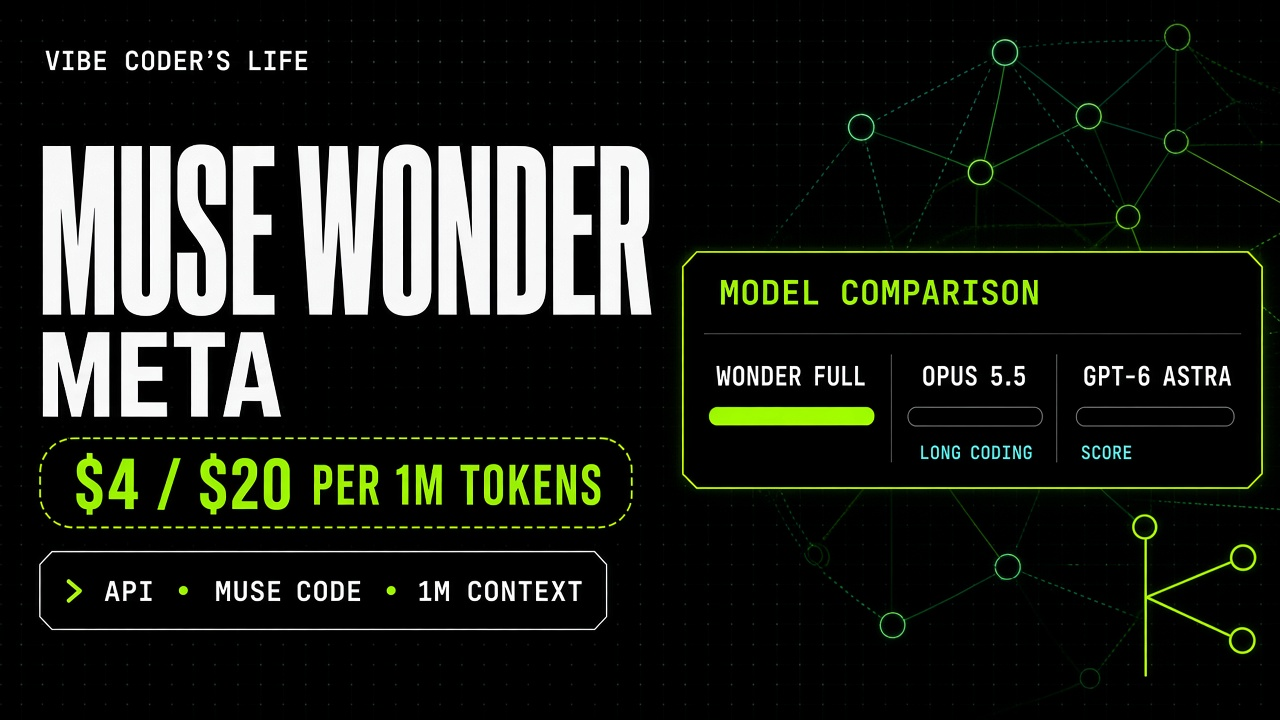
muse-wonder-1.0 at $4 / $20 per million input/output tokens with a 1M-token context. The stronger Muse Wonder Full is only in Muse Code's $50 and $200 plans.This is an AI news briefing, not a hands-on review. Meta shipped Muse Wonder on Monday, 12 October; I checked the launch post, model card and Model API docs against what I already covered on Muse Spark and Muse Code pricing. If you only need price, availability and Meta's own score sheet, this page is the short version.
What is Muse Wonder?
Muse Wonder is a series of two models: Muse Wonder and Muse Wonder Full. Meta calls them its most capable models yet, aimed at "personal and professional agentic tasks", and says they were trained at its gigawatt-scale Prometheus data center. Per the model card, both take text, image, video and audio input, return text, and handle 1M tokens of context (the API docs list 1,048,576 tokens, plus PDF input and reasoning effort from minimal to max).
Meta frames two ideas around it: Active Memory, carrying important context about you across conversations and pulling it back when it's relevant, and Active Focus, sticking with a hard goal by trying alternatives, working through blockers, asking for clarification and checking in before important actions.
What Muse Wonder can do
- Frontier coding: Meta's docs say it makes and verifies changes across many files in real repositories, plans, delegates to sub-agents, calls tools in parallel and recovers from errors over many steps.
- Long-running agents: Meta pitches multi-step tasks that "run for hours", and tests sustained work with its SWE-Marathon and FocusBench evals.
- Computer use: agents that see and operate browsers, desktop and mobile apps. Meta's demos include a running plan built across apps, custom swag ordered from Instagram photos, a wedding seating chart and a playable 3D kitchen game built from image inputs.
- Domain work: law, finance and health tasks, such as understanding a lease or financial and health information.
- Everything else in the API: chat, image, video and audio understanding, tool calling, structured output and search grounding.
Muse Wonder benchmarks: Meta's comparison sheet
This is Meta's full evaluation table from the launch post, transcribed cell by cell. Meta compares Muse Wonder Full and Muse Wonder against Claude Fable 5.1, GPT-6 Astra and Claude Opus 5.5, all at max reasoning effort. Every number here is Meta-reported; the model card says some come from third parties (Artificial Analysis, Vals AI, Surge) and that Meta's own competitor runs are "best-effort".
| Benchmark | Muse Wonder Full (max) | Muse Wonder (max) | Claude Fable 5.1 (max) | GPT-6 Astra (max) | Claude Opus 5.5 (max) |
|---|---|---|---|---|---|
| Personal and professional agents | |||||
| Personal Superintelligence Index Internal composite of personal and knowledge work | 59.1 | 54.3 | 49.9 | 54.5 | 55.2 |
| Harvey LAB-AA Legal agent work | 13.1 | 10.0 | 6.4 | 8.6 | 4.2 |
| Vals Finance Agent V2 Financial analyst research | 59.1 | 56.6 | 58.9 | 53.5 | 58.6 |
| HealthBench Pro Open-ended health queries | 62.3 | 60.5 | 62.1 | 65.3 | 65.6 |
| AutomationBench-AA E2E business workflows | 45.4 | 39.1 | 32.1 | 41.6 | 41.2 |
| GDP.pdf Professional work | 33.2 | 30.8 | 27.6 | 34.2 | 30.6 |
| JobBench Professional tool use | 75.3 | 70.5 | 73.1 | 66.1 | 75.4 |
| OSWorld V2.1 Agentic computer use (partial / binary) | 78.4 / 39.4 | 72.6 / 34.3 | 80.7 / 43.1 | 75.8 / 34.3 | 81.8 / – |
| MemoryBench Remembering context | 85.5 | 85.6 | 79.0 | 81.4 | 81.5 |
| Coding | |||||
| Terminal-Bench 4.0-AA Agentic terminal coding | 57.1 | 52.0 | 52.0 | 59.1 | 59.6 |
| DeepSWE 1.1 Long horizon coding | 79.0 | 78.8 | 67.4 | 74.1 | 74.2 |
| SWE-Marathon Ultra-long horizon engineering | 57.5 (xhigh) | 53.1 | 45.6 | 42.5 | 46.3 |
| ProgramBench From scratch programming | 59.0 | 50.0 | 55.5 | 52.5 | 70.5 |
| General | |||||
| Artificial Analysis Index | 56 | 52 | 53 | 53 | 58 |
How I read it: Wonder Full wins most clearly on long coding work (SWE-Marathon 57.5, DeepSWE 79.0) and agent workflows (AutomationBench-AA 45.4, Harvey LAB-AA 13.1). Claude Opus 5.5 still leads on ProgramBench (70.5 vs 59.0), Terminal-Bench and OSWorld, and tops the Artificial Analysis Index at 58. The regular Muse Wonder, the one you can actually call over the API, lands close to Opus 5.5 rather than above it on most rows.
Muse Wonder pricing and availability (including the EU and Hungary)
- Muse Wonder on Meta Model API: model ID
muse-wonder-1.0, $4.00 per million input tokens, $0.20 cached input, $20.00 output. Web search grounding is extra ($2.50 per 1,000 queries). Standard mode only — Contributor mode is not offered for Wonder on pay-as-you-go — so prompts and outputs aren't used for training. Meta labels the model "in preview". Rate limits on the pricing page: 3,000 RPM / 4M TPM. - Muse Wonder in Muse Code: on pay-as-you-go and every subscription plan.
- Muse Wonder Full: not on the API. Only in Muse Code on Power Usage ($50/month) and Maximum Usage ($200/month). Choosing
maxeffort on Muse Wonder does not give you Full. - Contributor mode: on by default for Muse Code subscribers (more usage in exchange for Meta training on your content), and you can turn it off. It isn't offered for Muse Wonder on pay-as-you-go.
- The Muse app: Meta says Wonder will "soon" power Muse experiences, rolling out first to subscribers. No date or country list yet.
From Hungary and the EU: Meta's Model API Geographic Use Policy, updated on launch day, lists no EU country among its restricted territories, and its only model-specific block is Muse Image in India. Muse Wonder and Wonder Full have no country restriction. The catch: Meta says access exists only where it has enabled it, and it doesn't publish a full allow-list. The model card also names Meta Platforms Ireland Limited as a model provider alongside Meta Platforms, Inc.
Muse Wonder for vibe coders and indie builders
Fast path by where you already sit (docs-based — I have not run Wonder on a private repo yet):
- Already on Muse Code Power or Max: Wonder Full is the headline model. That is where Meta's strongest coding rows live. Turn Contributor mode off first if you ship client code.
- Already on Muse Spark via API: Meta says Wonder and Spark share the same endpoints (Responses, Chat Completions, Messages) and OpenAI SDK compatibility. Swap the model ID to
muse-wonder-1.0for hard multi-file / multi-hour agent work; keep Spark 1.3 for cheap tight loops. - On a flat ~$20 IDE / agent plan: this launch is context, not a forced switch. Wonder's list price matches Opus 5.5 at $4/$20 — it is a frontier token bill, not a Cursor Pro replacement.
- Building agents in the EU / Hungary: Model API Geographic Use Policy does not list EU countries as restricted for Wonder; Meta still does not publish a full allow-list, so confirm your account actually has access before you redesign a stack around it.
How this fits prior VCL posts
- Meta Muse Spark — the earlier agentic coding model and Instagram / EU privacy opt-out steps.
- Muse Code vs Claude Code and Cursor — pay-as-you-go Muse Code setup and mid-range price band (Spark-era rates; Wonder is the new frontier tier).
- Free AI API keys for vibe coding (2026) — starter keys across providers when you are still exploring, not committing to $4/$20.
- My vibe coding stack in 2026 — how the rest of the stack sits next to whatever model you call.
- When the models went dark — why a spare model lane still matters when one frontier provider blinks.
Muse Wonder FAQ
What is Muse Wonder?
Muse Wonder is Meta's most capable model family, launched on 12 October 2026 by Meta's research team. It comes in two variants, Muse Wonder and Muse Wonder Full, built for coding, long-running agents and computer use. Both take text, image, video, audio and PDF input, return text, and have a 1M-token context window.
How much does Muse Wonder cost?
On Meta Model API, Muse Wonder (muse-wonder-1.0) costs $4.00 per million input tokens, $0.20 per million cached input tokens and $20.00 per million output tokens. Muse Wonder Full has no per-token price: it comes with the Muse Code Power Usage plan ($50 a month) and Maximum Usage plan ($200 a month).
What is the difference between Muse Wonder and Muse Wonder Full?
Muse Wonder Full is the higher-capability variant and scores higher on most of Meta's benchmarks, for example 59.1 vs 54.3 on Meta's Personal Superintelligence Index. Muse Wonder is on the API and in every Muse Code plan; Wonder Full is only in Muse Code on the Power and Maximum plans. Setting reasoning effort to max on Muse Wonder doesn't switch you to Full.
Is Muse Wonder better than Claude Opus 5.5?
On Meta's own comparison sheet, Muse Wonder Full beats Claude Opus 5.5 on 8 of 14 rows, including SWE-Marathon (57.5 vs 46.3) and DeepSWE 1.1 (79.0 vs 74.2). Opus 5.5 leads on HealthBench Pro, JobBench, OSWorld V2.1, Terminal-Bench 4.0-AA, ProgramBench and the Artificial Analysis Index. These are Meta-reported numbers, so test on your own tasks.
Is Muse Wonder available in the EU and Hungary?
Meta's Model API Geographic Use Policy (updated 12 Oct 2026) doesn't list Hungary or any EU country among its restricted territories, and Muse Wonder has no model-specific country restriction. Meta also says the API is only available where it has enabled access, without publishing a full country list. Meta hasn't said which countries get Muse Wonder inside the Muse app.
Is Muse Wonder free?
No. As of October 2026 Muse Wonder is a paid model: pay-as-you-go on Meta Model API or through a Muse Code plan. Meta's docs say Contributor mode, which trades your content for training in exchange for more usage, isn't available for Muse Wonder on pay-as-you-go. Muse Code subscribers get Contributor mode on by default and can switch it off.
Source: Meta AI Research: Muse Wonder (12 Oct 2026). Benchmark figures are Meta-reported. Docs-only — no hands-on Muse Wonder run yet.
Disclosure: no paid placement. None of the links in this post are referral links.
Questions? Get in touch — or subscribe for the next AI news post.