Claude Fable 5.2 is here. Do you really need it for vibe coding?
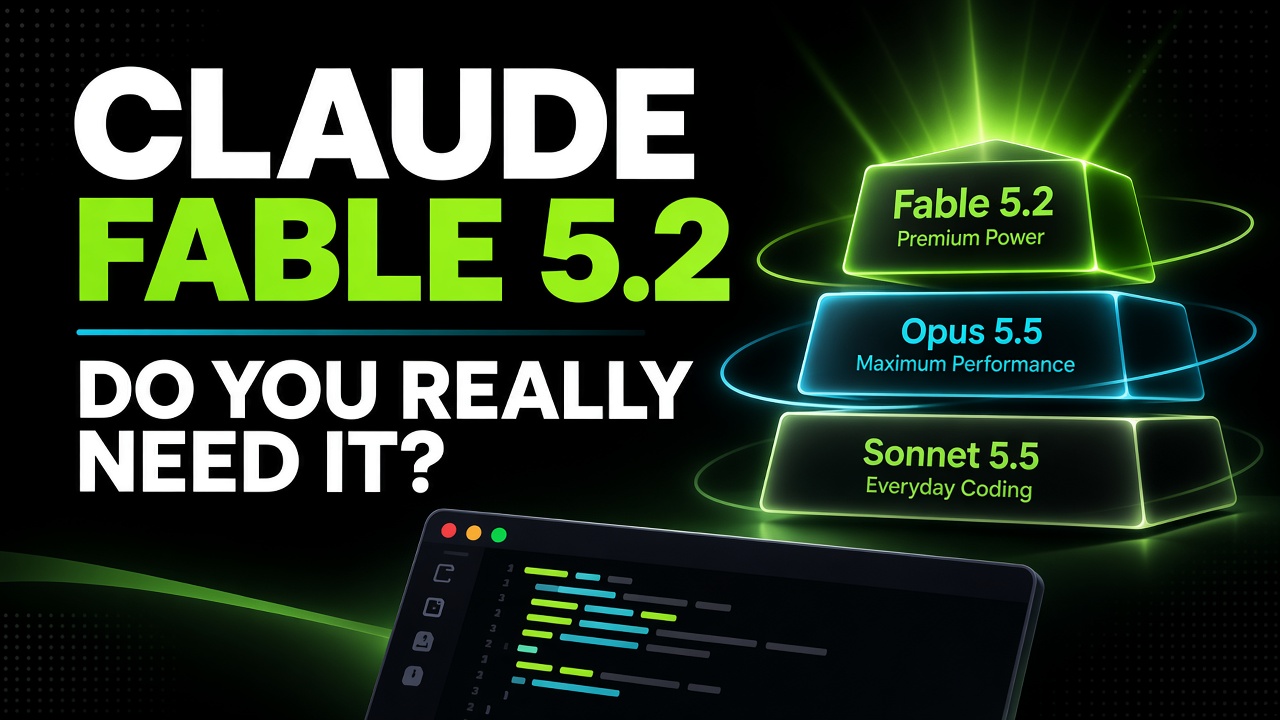
Fable 5.2 is Anthropic's strongest model you can actually use, and it's 20% cheaper than Fable 5.1. I haven't needed it yet: my daily driver is still Sonnet 5.5, with Opus 5.5 for the hard parts. Here's when each model earns its tokens, and what Pro users actually get this week.
~8 min read
TL;DR
- Do you need Fable 5.2 for vibe coding? Probably not. I haven't needed it yet.
- Price: $8 / $40 per million tokens. That's 2x Opus 5.5 and 4x Sonnet 5.5, and a 20% cut from Fable 5.1.
- My split: Sonnet 5.5 builds, tests and deploys. Opus 5.5 plans and handles auth and payments. Fable is only for when Opus gets stuck.
- Claude Pro: Fable normally runs on paid usage credits. Anthropic says it's included up to 50% of your weekly limit until 16 Nov. That's a usage offer, not a half-price sale.
Confession first: I haven't used Fable 5.2 yet. I'm not against it. I just haven't worked on any project that Opus 5.5 couldn't handle.
Most of what I build is landing pages, small SaaS features, Apify Actors and bug fixes, and that work doesn't need the biggest brain in the room.
So this one is short and practical: what Fable 5.2 actually is, what it costs, what my Pro account actually shows, and where it would fit next to the models I already use every day.
If you missed how we got here, the September launches of Opus 5.5 and Sonnet 5.5 are in my September 2026 AI recap.
If you read Tuesday's newsletter, you've already had the short version: price, speed and Anthropic's benchmark table. This post is the longer one, about what all that means when you're actually vibe coding.
What's new in Fable 5.2
The headline facts, all from Anthropic's own launch post and model docs:
- Released 9 Nov 2026. Model ID
claude-fable-5-2, available in the Claude apps, Claude Code, the Claude Platform, AWS, Google Cloud and Microsoft Foundry. It's also in Cursor's model list. - Cheaper than 5.1: $8 input / $40 output per million tokens, down from $10 / $50 on Fable 5.1. That's a 20% price cut, not 50%.
- Faster: up to 30% faster output than Fable 5.1. There's also an optional fast mode (up to 2.5x faster) at $16 / $80.
- 1M-token context and 128K max output, the same as Opus 5.5 and Sonnet 5.5.
- Mythos 5.2 is the same model without some of the cyber and biology safeguards, and only verified organisations get it. For us, Fable is the one that matters.
- Anthropic says Fable 5.2 beats Opus 5.5 on almost every benchmark it ran. The coding one I care about is FrontierCode 2.0, which checks whether maintainers would merge the model's code changes. At its top effort (Xhigh), Fable 5.2 scores 49.1%, against Opus 5.5's best of 45.5% (at Max). The more useful detail for us: at High effort, Fable scored 45.3%, about level with Opus at Max, for roughly half the cost per task. These are Anthropic's numbers, not independent tests.
Fable 5.2 vs other frontier models: the comparison sheet
Anthropic benchmarks: Fable 5.2 vs Fable 5.1 vs Opus 5.5
First, the upgrade itself. Here are four rows from Anthropic's launch table, plus the gap I actually care about: how far ahead of Opus 5.5 each one is.
| Benchmark | Fable 5.2 | Fable 5.1 | Opus 5.5 | Fable 5.2 vs Opus |
|---|---|---|---|---|
| FrontierCode 2.0 agentic coding | 49.1%1 | 32.4%1 | 45.5%2 | +3.6 |
| FrontierSWE v2 agentic coding | 69.9% | 56.3% | 62.3% | +7.6 |
| OSWorld 2.1 computer use | 89.3%3 | 83.5% | 87.2% | +2.1 |
| Humanity's Last Exam with tools | 74.2% | 65.6% | 67.7% | +6.5 |
Anthropic-reported figures from the Fable 5.2 launch post, with safeguards on, not independent tests. All scores use each model's highest available effort unless noted. 1 = Xhigh effort. 2 = Opus 5.5's best (Max). At High effort Fable 5.2 scores 45.3% on FrontierCode. 3 = OSWorld 2.1 offline set, partial. Gaps are percentage points.
Fable 5.2 next to the other models
Here's Fable 5.2 next to the models I actually switch between, plus OpenAI's and Google's current flagships. All the numbers come from the labs' own pages and Cursor's public leaderboard.
| Model | Price in / out per 1M tokens | Cache read | Context | FrontierCode 2.0 Anthropic table | FrontierSWE v2 Anthropic table | CursorBench 4.0 best score · cost per task |
|---|---|---|---|---|---|---|
| Claude Fable 5.2 | $8 / $40 | $0.20 | 1M | 49.1% Xhigh | 69.9% | 60.0% · $32.79 Max |
| Claude Opus 5.5 | $4 / $20 | $0.20 | 1M | 45.5% | 62.3% | 57.8% · $13.43 Max |
| Claude Sonnet 5.5 | $2 / $10 | $0.10 | 1M | — | — | 55.5% · $7.05 Max |
| Grok 4.7 Cursor | $2 / $6 | $0.50 | 256K 500K at 2x | — | — | 46.3% · $6.01 Xhigh |
| GPT-6 Astra OpenAI | $10 / $50 | $1.00 | 1.05M | 42.8% | 65.5% | — not listed |
| Gemini 4 Carbon Google | $2 / $10 intro to 30 Nov, then $4 / $20 | $0.10 then $0.20 | 1M | 41.1% Medium | 61.2% | 60.4% · $9.22 High |
Prices: Anthropic pricing docs, Cursor docs (Grok 4.7 on-demand rates beyond the Cursor models pool), OpenAI API pricing (short-context rates), and Google's Gemini API pricing. FrontierCode 2.0 and FrontierSWE v2 come from the table in Anthropic's Fable 5.2 launch post (highest available effort unless noted). Anthropic didn't list Sonnet or Grok there. CursorBench 4.0 is Cursor's own leaderboard. GPT-6 Astra isn't on it. "—" = no published number.
Do you really need it for vibe coding?
Here's the honest bit. Anthropic itself doesn't tell you to start on Fable. Its launch post says to start most coding with Opus 5.5, "our strongest daily driver", and to move up to Fable or down to Sonnet depending on the job. Anthropic's own model guide goes further: move up to Fable "when Opus 5.5 at high still falls short, or for long unattended runs."
Anthropic's default is Opus. Mine is Sonnet 5.5, because on a $20 plan it gives me the most usage without burning through my limits:
- It's half the token price of Opus. On Pro that doesn't show up as a lower bill. It shows up as more building before you hit your limit.
- It's close on most of the numbers. On Anthropic's Sonnet 5.5 launch table, Sonnet trails Opus on 7 of 8 benchmarks, mostly by small margins. On Terminal-Bench 4.0 it actually scores higher (70.6% vs 66.4%), though Anthropic lists error bars of about ±2.5 points per model on that test.
- Where Opus pulls away is the hard stuff. On SWE-bench Pro (large, multi-file fixes in real repos), Opus 5.5 scores 89.9% against Sonnet's 81.3%. Anthropic also says Opus "remains clearly stronger at complex, open-ended work requiring sustained judgment."
That's why I use Opus for the thinking and Sonnet for the doing. Fable would be the next rung up, and so far I haven't needed it.
Which model when: quick pick
Sonnet 5.5
Build, test, deploy
My daily driver. Features from a plan, bug fixes, UI, deploys.
Opus 5.5
Plan, auth, payments
Planning, reasoning, complex topics, and anything security- or money-related.
Fable 5.2
When Opus is stuck
Long multi-file migrations, big refactors, agent runs that go for hours.
Grok 4.7
Everyday Cursor agent
Swap in for Sonnet on everyday features when you're working in Cursor.
How I actually work: Opus plans, Sonnet ships
I work in one of two places: the Cursor agent, or Claude Code in the CLI inside Cursor's desktop terminal. Same editor, same repo, and I just pick the model for the job.
- Plan with Opus 5.5 at High. Ask for a written plan that includes the test cases and what "done" means. Opus defines done, so Sonnet isn't grading its own homework.
- Hand the plan over as a document, not a chat. Switching models drops the earlier model's hidden reasoning when the new model can't read it (a smaller model never reads a bigger one's), so the plan has to stand on its own. Anthropic's tip: run
/compactor start a fresh session with the short written plan. - Build, test and deploy with Sonnet 5.5. Medium effort for routine work, High for trickier bits. Anthropic says Sonnet complements Opus best at lower effort settings. At the top settings it costs about the same as Opus, so if Sonnet needs Max to get through a task, switch to Opus instead.
- Auth and payments go back to Opus. Login flows, checkout and billing logic, database migrations and anything touching production data get Opus, either to write it or to review it before I ship.
- Escalate to Fable only when Opus at High is stuck. Anthropic's model guide gives the same order: first make sure the model can check its own work (a test, a build, a script), then raise effort one level, then move up a model.
Claude Code shortcuts (model docs):
/model sonnet,/model opusor/model fableswitches models mid-session. Fable 5.2 needs Claude Code v2.1.321 or later, so runclaude updatefirst./effortsets the effort level. The default is Medium in Claude Code for Sonnet 5.5, Opus 5.5 and Fable 5.2, so raise it to High on purpose for the planning step./model opusplanplans with Opus in plan mode and then executes with Sonnet automatically. It's the lazy version of steps 1 to 3. Anthropic suggests measuring it on your own tasks before you make it your default.
Sonnet 5.5 or Grok 4.7? Easy to swap
The other reason I don't stress about model launches: in Cursor I can swap between Claude models and Cursor's own Grok 4.7 without changing how I work. For everyday building they're close enough on price and coding scores that I just pick whichever one my plan's usage favours that day.
The numbers, from the official pages:
- Price: Grok 4.7 is $2 / $6 per million tokens in Cursor (docs), Sonnet 5.5 is $2 / $10. Same input price, and Grok's output is 40% cheaper. Grok 4.7 also draws from the Cursor models pool included with every paid Cursor plan, and those prices only apply beyond the pool.
- CursorBench 4.0 (Cursor's own test on real, multi-file Cursor tasks, from its leaderboard): at High effort, Sonnet 5.5 scores 47.8% and Grok 4.7 43.9%. At Medium, Grok leads 41.6% vs 39.2%. At their top settings Sonnet pulls ahead: 55.5% at Max vs Grok's 46.3% at Extra High.
- Where they're not close: on Terminal-Bench 4.0, Anthropic reports 70.6% for Sonnet 5.5 and Cursor reports 37.6% for Grok 4.7 (Grok 4.7 page). Different labs ran those tests, but it's a big gap for long terminal work. Sonnet also has a 1M context window against Grok's 256K standard.
My $20 AI coding subscription guide has more on Cursor vs Claude Pro, and Grok 4.5 is the first fruit of the Cursor acquisition covers where Cursor's Grok line started.
Fable on Claude Pro vs Max (and this week's launch offer)
I pay for Claude Pro, so I checked this part against my own account and Anthropic's help center (launch offers and Fable on your plan).
What I see on my Pro account: a single "Reset for free" button that says "Refills your Fable allowance and 5-hour limit, and returns what Fable used to your weekly limit." My working assumption has been that Pro has no included Fable at all, only on-demand credits. So for me, the useful part of that button is the 5-hour refill.
What Anthropic says:
| Plan | Fable normally | This week (launch offer) |
|---|---|---|
| Pro ($20/month, $17 billed yearly) and Team standard seats | Not included in your plan limits. Runs on pay-as-you-go usage credits at API rates from the first message | Fable included until 16 Nov, for up to 50% of your weekly limit, plus one Fable limit reset |
| Max, Ultra, Team premium seats | Included, up to 50% of your weekly limits | One to three Fable resets, depending on how long you've subscribed (valid until 8 Mar 2027) |
| Free | Not available | Not included |
So on paper Pro does get a week of included Fable, even though I'd assumed it was credits-only. The "Fable allowance" wording on my reset button fits that. Since I haven't picked Fable in the model picker, I can't tell you from experience whether it draws from your plan or your credits. If you want to try it, check Settings > Usage before and after one small Fable prompt.
The fine print:
- Dates: the Pro offer runs from 9 Nov until 16 Nov, 11:59 pm PT (that's Tue 17 Nov, 08:59 Budapest time). After that, Fable goes back to usage credits, and the unused allowance doesn't carry over.
- Resets only go to accounts with paid billing in place before 9 Nov, 10:00 am PT (19:00 Budapest time). Check Settings > Usage to see what your account actually got.
- A Fable reset does two things: it gives back the weekly usage you spent on Fable, and it refills your whole 5-hour window, including Sonnet and Opus usage. It doesn't raise your limits. Claim it in Settings > Usage > Limit resets > "Reset for free" on web, desktop or mobile, because the button isn't in Claude Code yet. The usage it restores still counts in Claude Code.
- Your default model doesn't change. You have to pick Fable in the model picker, or with
/model fablein Claude Code. - Fable eats your limits faster than other models. On Pro, that can mean less Sonnet and Opus time for the rest of the week.
- Usage credits are switched on in Settings > Usage, where you can set a monthly spend limit. They're billed on top of your subscription.
Is Fable half price this week? No. The price cut is permanent and it's 20% ($10/$50 down to $8/$40). The "50%" you've probably seen is the share of your weekly limit that Pro users can spend on Fable until 16 Nov.
Cost reality check
Here's some simple list-price maths for one chunky feature session: 400K fresh input tokens and 100K output tokens, with no caching.
| Model | Input | Output | Session cost |
|---|---|---|---|
| Grok 4.7 (Cursor, beyond the pool) | $0.80 | $0.60 | $1.40 |
| Sonnet 5.5 | $0.80 | $1.00 | $1.80 |
| Opus 5.5 | $1.60 | $2.00 | $3.60 |
| Fable 5.2 | $3.20 | $4.00 | $7.20 |
| Fable 5.2 fast mode | $6.40 | $8.00 | $14.40 |
Two things make this less scary in real life:
- Long sessions are mostly cache reads, and Fable's cache reads cost the same $0.20 per million as Opus. On long, cache-heavy runs the gap mostly comes down to fresh input and output.
- Price per token isn't price per finished task. If Opus needs Max effort and three retries, Fable at High can come out cheaper. That's exactly what Anthropic's FrontierCode 2.0 chart claims (about half the cost per task at the same score). Cursor's leaderboard shows the same effect the other way round: Sonnet 5.5 at High averaged $1.20 per task against Grok 4.7's $4.69, despite Grok's cheaper tokens.
On Pro you don't pay these numbers for Sonnet or Opus, because they come out of your plan's limits. After 16 Nov you do pay them for Fable, from usage credits. That's why Fable stays a "when stuck" tool for me, not a default.
Want next week's model notes before everyone else?
Related on Vibe Coder's Life
- OpenAI DevDay 2026 + September AI recap: when Opus 5.5 and Sonnet 5.5 launched, plus the Fable 5.1 backstory
- Which AI coding tool should you pay $20 for?: Claude Pro next to Cursor, Codex and Antigravity
- My vibe coding stack in 2026: where Claude and Cursor sit in my daily tools
- Grok 4.5 is the first fruit of the Cursor acquisition: the start of Cursor's Grok models
- Muse Wonder: Meta pricing, API and benchmarks vs Opus 5.5: another frontier model measured against Opus 5.5
- Opus 4.8 is live, and so is Vibe Coder's Life: where this blog started, one Claude model at a time
FAQ
Is Claude Fable 5.2 worth it for vibe coding?
For most vibe coding, no. Sonnet 5.5 handles building, testing and deploying at a quarter of Fable's token price, and Opus 5.5 covers planning, auth, payments and hard debugging. Fable 5.2 earns its price on long multi-file migrations, big refactors and agent runs where Opus 5.5 at High effort still falls short, which is also what Anthropic's own model guide recommends.
Is Claude Fable 5.2 available on Claude Pro?
Yes, but normally not inside your plan limits. On Pro, Fable models run on pay-as-you-go usage credits at API rates. As a launch offer, Anthropic says Pro includes Fable for up to 50% of the weekly limit, plus one Fable limit reset, until 16 Nov 2026, 11:59 pm PT. Check Settings > Usage to see what your account shows. Max and Ultra include Fable for up to 50% of weekly limits as standard.
Is Claude Fable 5.2 half price this week?
No. Fable 5.2's API price is $8 / $40 per million tokens, a permanent 20% cut from Fable 5.1's $10 / $50. What runs this week is a usage offer: Pro and Team standard seats can spend up to 50% of their weekly limit on Fable at no extra cost until 16 Nov, and Max and Ultra get one to three Fable limit resets.
What does the Claude "Reset for free" button do?
It's the Fable limit reset from the Fable 5.2 launch. It gives back the weekly usage you spent on Fable models and refills your whole 5-hour window, including usage on Sonnet and Opus. It doesn't raise your limits and can't be undone. On Pro it expires 16 Nov 2026, 11:59 pm PT, so if you don't use Fable, save it for when you hit your 5-hour cap.
Is Fable 5.2 better than Opus 5.5 for coding?
On Anthropic's benchmarks, yes. Fable 5.2 leads Opus 5.5 on almost every test it published, including 69.9% vs 62.3% on FrontierSWE v2. On FrontierCode 2.0, Fable reaches 49.1% at Xhigh against Opus's best of 45.5%, and at High effort it roughly matched Opus at Max (45.3% vs 45.5%) for about half the cost per task. But Fable costs twice as much per token, so Anthropic still recommends starting everyday coding on Opus 5.5.
Is Grok 4.7 in Cursor as good as Claude Sonnet 5.5?
For everyday coding they're close. On Cursor's CursorBench 4.0, Sonnet 5.5 scores 47.8% at High effort and Grok 4.7 43.9%, while Grok leads at Medium (41.6% vs 39.2%). Both cost $2 per million input tokens; Grok's output is $6 against Sonnet's $10. Sonnet is clearly ahead on Terminal-Bench 4.0 and has a 1M context window against Grok's 256K.
How do I use Fable 5.2 in Claude Code?
Update to Claude Code v2.1.321 or later with claude update, then run /model fable or launch with claude --model fable. From that version the fable alias points to Fable 5.2 (except in Claude apps gateway sessions). Use /model sonnet or /model opus to switch back, and /effort to set the level, which defaults to Medium. When Fable bills to usage credits, the model picker shows "Requires usage credits".
Sources: Anthropic: Claude Fable and Mythos 5.2. Checked 13 Nov 2026.
Disclosure: No sponsorship or affiliate links in this post. Claude benchmarks are Anthropic-reported, Grok 4.7 benchmarks are Cursor-reported, and CursorBench is Cursor's own leaderboard. Prices are list prices in USD as of 13 Nov 2026.
Questions? Get in touch — or subscribe for the next issue.