Gemini 4 Hydrogen, Argon, and Carbon: can you vibe-code on Google alone?
September ended with Argon still locked to Fairwind. Then Google opened Argon to everyone, shipped Carbon, then Hydrogen — in about a month. Here's the roster, the plan matrix, and whether Antigravity alone is a solid vibe-coding setup.
~9 min read
TL;DR
- Google didn't slow down after September. Argon went live for everyone (not Fairwind-only), then Carbon, then Hydrogen — a full Gemini 4 ladder in about a month.
- Google-only stack that actually works: Google AI Pro (~$20) + Antigravity. Use Hydrogen for everyday builds, Argon for hard planning, Carbon only on Ultra (or when Pro quotas die).
- "Google-only" means Gemini models on purpose. Antigravity Pro also ships Claude Sonnet/Opus 5.5 — that's the escape hatch, not the thesis.
- API: Hydrogen $1.50 / $7.50 (free tier in AI Studio). Argon and Carbon intro $2 / $10 through 30 Nov, then $4 / $20.
In my September 2026 AI recap, Gemini 4 Argon landed on 30 Sep as a frontier model you mostly couldn't use yet — Fairwind only, with a "keep 3.8 Flash warm" note.
That was the wrong read on Google's pace.
Flash had already been on a sprint (3.6 → 3.7 in three weeks). Then Argon went live for developers on 13 Oct, Carbon on 10 Nov, and Hydrogen on 12 Nov. The interesting question for vibe coding isn't "is Gemini competitive?" anymore. It's: if you only had Google — Antigravity, the Gemini app, and the Gemini API — would that be a solid setup?
This post is that answer: roster, prices, which plan unlocks which model, and a Google-only workflow. Rumors about Oxygen and Helix stay in their own section and stay labeled as rumors.
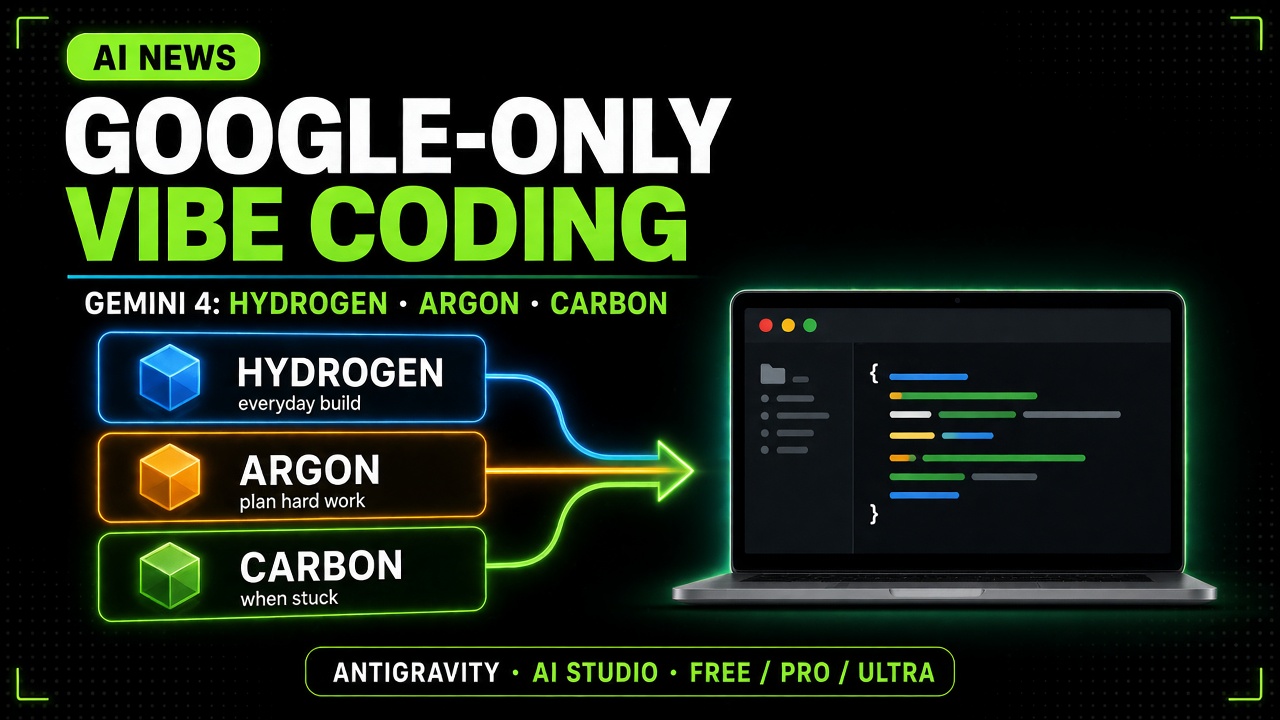
The Gemini 4 roster
Google's own positioning, translated into vibe-coding jobs:
Hydrogen
Build, test, iterate
Fast everyday coding and agentic execution. The daily driver once you're on Pro or Ultra in Antigravity — or free in AI Studio with rate limits.
Argon
Plan + most hard work
Efficient frontier reasoning. Google says it's the right pick for the majority of software engineering and knowledge work.
Carbon
When Argon is stuck
Strongest Gemini 4 model. Longer horizons, denser verification loops, more tokens per turn than Argon.
Antigravity
Google's agent IDE
Desktop, CLI, and IDE where you pick Hydrogen, Argon, or Carbon (by plan). Free tier still runs 3.8 Flash — Gemini 4 coding needs Pro or Ultra.
Official announcements: Argon live for everyone · Carbon live · Hydrogen · Antigravity models.
Prices and benchmarks
API list prices (as of mid-Nov 2026)
Swipe sideways for the full table →
| Model | API id | Free tier | Paid in / out per 1M tokens | Context |
|---|---|---|---|---|
| Gemini 4 Hydrogen | gemini-4-hydrogen | Yes (rate-limited) | $1.50 / $7.50 flat | 1M unified |
| Gemini 4 Argon | gemini-4-argon | No | $2 / $10 intro · $4 / $20 from 1 Dec | 1M unified |
| Gemini 4 Carbon | gemini-4-carbon | No | $2 / $10 intro · $4 / $20 from 1 Dec | 1M unified |
From Gemini API pricing. Intro prices for Argon and Carbon run through 30 Nov 2026. Cached input is discounted ~95% (Hydrogen ~$0.075; Argon/Carbon $0.10 intro, then $0.20). Thinking tokens count as output.
Scores worth caring about for coding
These are lab- or leaderboard-reported numbers, not my own bake-off. Labels matter.
Swipe sideways for the full table →
| Signal | Hydrogen | Argon | Carbon | Where from |
|---|---|---|---|---|
| AA Intelligence Index | 51 high · 54 xhigh | 50 | ~59 (v5.0 #1 at announce) | Google / Artificial Analysis via Google posts |
| CursorBench 4.0 best · $/task | — | — | 60.4% · $9.22 High | Cursor leaderboard (cited in Fable 5.2 post) |
| FrontierCode 2.0 | — | — | 41.1% Medium | Anthropic's Fable launch table |
| Terminal-Bench 4.1 | 57% vs 18.2% on 3.8 Flash | — | — | Google Hydrogen post |
Google-reported figures from the Hydrogen and Carbon announcement posts; CursorBench from Cursor's public board as of the Fable 5.2 comparison sheet (13 Nov). FrontierCode row for Carbon is Anthropic-reported, not Google's. "—" = no number in the sources above.
Which plan gets which model
This is the part that decides whether "Google only" is real or marketing.
Antigravity (the agent IDE)
From Google's Antigravity models docs:
Swipe sideways for the full table →
| Model | Free & AI Plus | AI Pro (~$20) | AI Ultra ($100 / $200) |
|---|---|---|---|
| Gemini 3.8 Flash | Yes | Yes | Yes |
| Gemini 4 Hydrogen | No | Yes (paid non-trial) | Yes |
| Gemini 4 Argon | No | Yes (paid / eligible device trial) | Yes |
| Gemini 4 Carbon | No | No | Yes |
| Claude Sonnet / Opus 5.5 | No | Yes (paid non-trial) | Yes |
Free and AI Plus share a column in Antigravity: you get 3.8 Flash (and older partner models that Google says drop on 18 Nov), not Hydrogen. Argon needs a paid Pro plan or an eligible premium-device trial; Hydrogen and Claude 5.5 need paid non-trial Pro.
Gemini app / Search (rough ladder)
- Free: Hydrogen via auto model selection when it's the right pick; not a full Carbon/Argon coding seat.
- AI Plus (~$5): Hydrogen access + higher limits than Free. Storage and Gemini-app productivity — not an Antigravity upgrade.
- AI Pro (~$20): Argon + Hydrogen in the app; four times Free usage (Google's wording).
- AI Ultra ($100 / $200): Carbon + Argon + Hydrogen at the highest limits; 5× or 20× Pro usage depending on Ultra tier.
API / AI Studio
- Hydrogen: free tier + paid.
- Argon and Carbon: paid tier only.
Setup for Antigravity itself is already covered in Free Google AI tools for vibe coding. The $20 fit guide for Pro vs Cursor vs Claude is in Which AI coding tool should you pay $20 for?.
A Google-only vibe-coding workflow
Assume the constraint: no Cursor, no Claude Code, no ChatGPT Codex as the daily path. Only Google surfaces.
$0 — try Gemini, don't pretend it's a full agent stack
- AI Studio / Gemini API: Hydrogen free with rate limits. Good for prompts, small scripts, and "is this model any good?"
- Antigravity free: still on 3.8 Flash for the agent loop. Useful to learn the product. Not the Gemini 4 experience.
~$20 Google AI Pro — the real Google-only setup
- Hydrogen in Antigravity for everyday features, bug fixes, tests, and deploys — the daily build model.
- Argon for architecture, auth, payments, nasty concurrency, or multi-repo migrations — plan and hard judgment.
- AI Studio / API with the same model ids when you want a prompt playground or a script outside the agent IDE.
- Stay off Claude in the Antigravity picker if you're testing the Google-only thesis. Switch to Claude only when you decide the experiment failed for that task.
~$100+ Ultra — when Pro isn't enough
- You need Carbon for the hardest long-horizon jobs.
- Or Pro's five-hour / weekly limits keep dying mid-week and Ultra's higher rate limits are cheaper than stacking a second vendor.
Cross-vendor ladder (VCL framing)
Google doesn't publish this table. I do — as a roles map, not a capability claim that Helix equals Luna.
Swipe sideways for the full table →
| Role | Google (Gemini 4) | OpenAI | Anthropic |
|---|---|---|---|
| Cheap / fast / lite | Helix rumor | Luna | Haiku |
| Daily build | Hydrogen | Terra | Sonnet |
| Plan + hard judgment | Argon | Sol | Opus |
| When stuck | Carbon | Astra | Fable |
Editorial mapping for vibe-coding jobs: Hydrogen ↔ Terra ↔ Sonnet; Argon ↔ Sol ↔ Opus; Carbon ↔ Astra ↔ Fable. Luna/Haiku sit with rumored Helix. Helix is unverified. For Anthropic pricing and when Fable earns its tokens, see Claude Fable 5.2 for vibe coding.
Rumors: Oxygen and Helix
Neither name appears on Google's official Gemini 4 list (Carbon, Argon, Hydrogen). Treat everything below as unverified.
- Oxygen. Community posts tied an unlabeled Arena routing checkpoint (~14–15 Nov) to a possible next Flash-class model named Oxygen. Google has not announced it. No public API id, price, or model card.
- Helix. Around 10 Nov, ArtificialWatch and others reported a personal GitHub project (later deleted) that mapped Flash → Hydrogen and Flash-Lite → Helix. Helix breaks the pure element naming. Still no Google confirmation and no public API listing as of mid-Nov.
If either ships, the Google-only ladder gets a true lite tier under Hydrogen. Until then, free Antigravity stays on 3.8 Flash, and AI Studio's free Hydrogen is the cheap Gemini 4 on-ramp.
Want next week's model notes before everyone else?
Related on Vibe Coder's Life
- OpenAI DevDay 2026 + September AI recap: Argon Fairwind watch note, GPT-6 family, Claude 5.5
- Gemini 3.7 Flash and Gemini 3.6 Flash: the Flash sprint cadence
- Claude Fable 5.2 is here. Do you really need it for vibe coding?: Carbon on the comparison sheet + Hydrogen short
- Which AI coding tool should you pay $20 for?: Antigravity Pro vs Cursor / Claude / Codex
- Free Google AI tools for vibe coding: Antigravity setup
- My vibe coding stack in 2026: where Gemini sits next to Claude and ChatGPT
FAQ
Can you vibe-code on Google alone with Gemini 4?
Yes, if "alone" means Google AI Pro + Antigravity on Gemini models (Hydrogen for everyday builds, Argon for hard planning). Free tier alone is not a full Gemini 4 agent stack in Antigravity — you stay on 3.8 Flash there. Ultra unlocks Carbon.
Is Gemini 4 Hydrogen free?
On the Gemini API and in Google AI Studio, yes, with rate limits. In Antigravity, Hydrogen needs Google AI Pro (paid non-trial) or Ultra. The Gemini app can route free users to Hydrogen via auto selection.
Do I need Google AI Ultra for vibe coding?
Only if you need Carbon, or Pro quotas aren't enough. Most of Google's "majority of software engineering" pitch sits on Argon, which Pro already unlocks.
When do Argon and Carbon leave intro pricing?
After 30 Nov 2026. List price moves from $2 / $10 to $4 / $20 per million input/output tokens (API).
What about Oxygen and Helix?
Rumors only as of mid-Nov 2026. No official Google announcement, no public API ids to treat as shipping products.
Sources: Google DeepMind Gemini 4 Argon / Carbon / Hydrogen posts; Antigravity models; Gemini API pricing; Google AI subscriptions. Checked mid-Nov 2026. Full checklist in the repo sources file.
Disclosure: No sponsorship in this post. Benchmarks are Google-, Anthropic-, or Cursor-reported as labeled. Prices are USD list prices. Oxygen and Helix are unverified rumors.
Questions? Get in touch — or subscribe for the next issue.